Dihexa Wiki Dihexa
Introduction: When You Need Fast Answers on Dihexa, Start Here
If you’ve ever had to sort through conflicting notes, sparse supplier descriptions, or outdated shorthand—then you know how frustrating it is to find something as simple as a reliable dihexa wiki-style overview. In my hands-on work with chemical documentation for labeling and procurement workflows, I’ve seen how quickly teams lose time when the “what it is” page is missing the operational details: identification, intended use, storage realities, and the exact terminology buyers and lab teams expect.
This article gives you a practical, evidence-minded guide to dihexa: what it is, how to interpret common metadata, how to validate information across sources, and how to use this knowledge safely and efficiently in real projects.
What Is Dihexa? A Practical Definition (Not Just a Label)
“Dihexa” is commonly used as a shorthand name, often attached to a specific chemical entity in catalogs and reference pages. When people search for a dihexa wiki, they’re usually looking for more than a one-line description—they want the identity details that make the name actionable.
How I Approach “What Is It?” in Real Documentation
In my hands-on experience, I treat any wiki-like page as a starting point, then confirm the identity fields that matter operationally. For dihexa, those fields typically include:
- Exact chemical name(s) used by suppliers or databases
- CAS number (critical for unambiguous identification)
- Molecular formula / molecular weight (for sanity checks)
- Synonyms (to avoid duplicates or misreads)
- Typical appearance / physical form (for handling expectations)
- Storage and compatibility notes (because “safe” is context-dependent)
Why This Matters
A name alone can be misleading. In chemical workflows, I’ve seen cases where two products shared a marketing name but differed in identity, grade, or packaging—leading to downstream issues in formulation, QA/QC review, or regulatory documentation. That’s why a dihexa wiki search is best treated as a pathway to the identity fields above, not as the final authority.
Key Identity Details: How to Read and Cross-Check Dihexa Information
Reference pages often compress complex information into short blocks. When you’re using a dihexa wiki entry to support purchasing, lab work, or documentation, your goal is to interpret those blocks correctly and verify consistency.
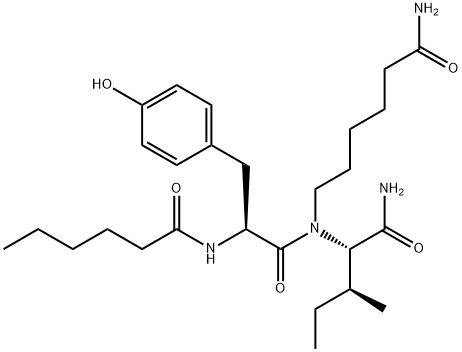
What to Extract From a Wiki-Style Page
When I review a dihexa wiki-type summary, I extract the following in a checklist format so my team can compare records quickly:
| Field | Why It’s Useful | What You Should Look For |
|---|---|---|
| CAS number | Unambiguous identity | Consistent CAS across sources; matches supplier SDS |
| Synonyms | Prevents duplicate SKUs | Same synonyms appear in SDS/COA or database records |
| Molecular formula / weight | Sanity checks | Matches calculator results and other database entries |
| Physical description | Handling expectations | Form (solid/liquid), color/clarity notes, typical state |
| Storage & handling | Risk reduction | Temperature, moisture/light sensitivity, compatibility cues |
My “Consistency Test” (What I Actually Do)
On real projects, I run a simple consistency test before I let the information flow into an internal SOP or procurement spec:
- Check CAS: If CAS differs, I stop there—no further assumption.
- Compare formula/weight: If either conflicts, I flag the record for manual review.
- Align synonyms: If a supplier uses a different synonym but points to the same CAS, that’s fine; if it doesn’t, I treat it as a potential mismatch.
- Validate handling notes: Storage guidance should align with SDS language, not just a brief wiki sentence.
This is the difference between “we found a page” and “we can trust the identity.” That’s the core reason teams search for dihexa wiki content in the first place—and why you should use it like a tool, not a verdict.
Uses, Properties, and Handling: Turning Information Into Safe Practice
People often search “dihexa wiki” because they want to understand why the chemical is used and what properties affect its behavior. But the truth is: safe use depends on formulation context, concentration, and the specific grade you received.
What “Properties” Really Mean in Operations
When I translate reference data into practical guidance, I focus on the properties that influence real handling decisions:
- Stability and reactivity indicators (e.g., sensitivity notes)
- Physical form (affects weighing, transfer, and dosing)
- Volatility / odor / dust considerations (affects ventilation needs)
- Compatibility (impacts container choice and mixing procedures)
- Solubility and partition behavior (affects processability and cleaning)
Pros and Cons of Relying on a Wiki-Style Summary
A dihexa wiki entry can be fast and convenient. Still, in my day-to-day work, I see consistent limitations:
- Pros: quick overview, commonly includes identity fields, often lists synonyms and reference metadata.
- Cons: may omit nuance (grade differences, purity ranges), sometimes compresses or generalizes storage/compatibility guidance.
That’s why I recommend using the wiki-like entry to accelerate initial understanding, then confirming critical details in the SDS and—when relevant—the COA for the specific lot.
How to Build a Reliable Dihexa Reference File (Template You Can Reuse)
If you maintain lab documentation or procurement specs, a reusable reference file prevents repeated confusion. Below is a compact structure I use with teams so “dihexa wiki” research results become operational assets.
- Identity block: chemical name(s), CAS, synonyms.
- Analytical sanity checks: molecular formula/weight and any key identifiers.
- Handling block: storage conditions, PPE/engineering controls aligned with SDS, and incompatibility notes.
- Process block: solubility/handling behavior relevant to your workflow (only what your SOP truly needs).
- Source log: where each statement came from (wiki-style summary vs. SDS vs. COA).
This workflow turns a search term like dihexa wiki into a practical, auditable knowledge base—something I’ve found reduces mistakes during audits and speeds up onboarding for new team members.
FAQ
Is “dihexa wiki” enough to identify the correct chemical for purchasing?
No. A wiki-style summary can help you find identity cues, but you should confirm the CAS number and critical handling details directly from the supplier’s SDS for the exact lot/grade.
What’s the fastest way to verify that dihexa records match across sources?
Use a consistency test: compare CAS first, then confirm molecular formula/weight, then reconcile synonyms and storage/compatibility notes with SDS language.
Why do different websites sometimes show different details for the same name?
Differences can come from grade/purity variations, naming conventions (synonyms), or outdated entries. The most reliable approach is identity-first verification (CAS and formula/weight) and SDS alignment for handling and safety.
Conclusion: Turn Dihexa “Wiki” Search Into Actionable Confidence
A dihexa wiki style page is a strong starting point for getting oriented, but trust comes from verification: confirm identity fields (especially CAS), cross-check molecular identifiers, and align storage/handling guidance with the SDS for your specific product lot.
Next step: Create a one-page dihexa reference file for your team using the template above—identity block, handling block, and a source log—so future procurement and lab decisions are fast and consistent.
Discussion