7 mins read | 02 Feb 2026 | Key words: IPv4 market 2025, IPv4 price decline, IPv4 address prices, IPv4 leasing, IPv6 adoption, IPv4 vs IPv6, IPv4 market outlook
A Market That No Longer Follows Old Rules
The year 2025 has marked a watershed moment in internet infrastructure history, fundamentally reshaping the economics of IPv4 addresses. Prices for the largest address blocks have experienced an unprecedented decline, shattering the scarcity-driven pricing model that dominated the market for over a decade.
A major milestone came in November 2025: the /16 block prices finally fell below $15 per IP.
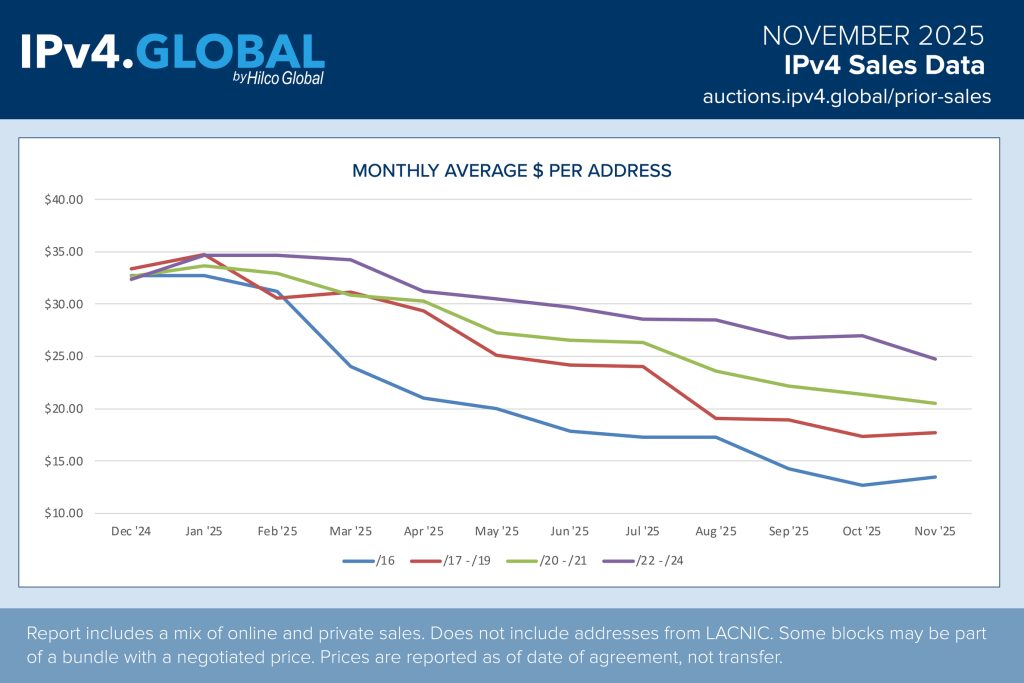
Figure 1: Average prices per address for IPv4 address blocks. [Source: IPv4.Global]
This represents a decline of more than 50% from the $30+ per IP price seen in October 2024. It’s a new reality driven by complex interplay between supply surges, changing buyer strategies, the rise of leasing models, and the gradual but persistent progress of IPv6 adoption.
The Surge in /16 Block Supply
The most dramatic factor driving the collapse is the unprecedented influx of large and unused address blocks entering the secondary market.
In April 2025, large IPv4 Address holders are monetizing their IP portfolios , potentially freeing up additional addresses for market release. Cogent Communications completed a landmark financial transaction by securitizing its IPv4 address assets, raising $174.4 million through a structured debt offering .
In August 2025, more than 4/16 were released from US-MARSHALS, which dramatically increased IPv4address supply. Approximately 750,000 IPv4 addresses sized from the Micro fraud case 2023.
The potential release of over 250 million reserved IPv4 addresses represents a future supply overhang that continues to influence market sentiment.
Buyers Have Changed to “wait-and-see” approach
The role of major buyers, particularly Hyperscalers (Amazon, Microsoft, Google) as price drivers, has fundamentally changed.
- Reduced Hyperscaler Demand: Hyperscalers have largely met their immediate needs and are relying more on IPv6 in new deployments. Through May 2025, they acquired only 13,028,352 addresses, a significant reduction from the 28,148,736 addresses acquired in 2024. This slowdown eliminated a major source of demand supporting premium pricing.
- Shift to Smaller Blocks: Enterprises are shifting from speculative bulk buying to surgical, precise allocations. Smaller blocks are preferred because they are easier to deploy and manage and align with “just-in-time” IP acquisition models.
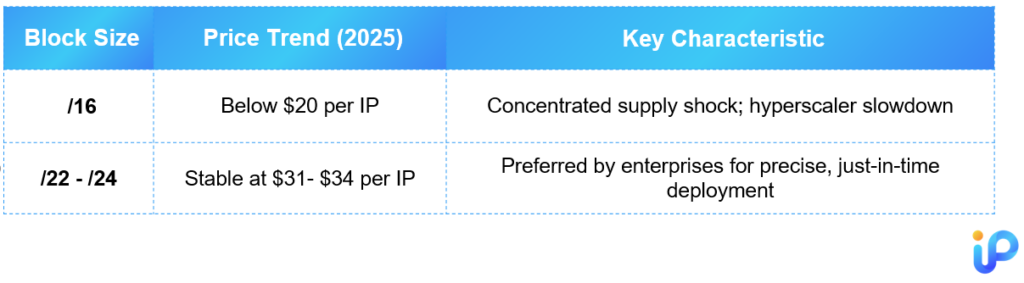
- Strategic Patience: Buyer behavior is characterized by heightened price consciousness and strategic patience. With prices declining, many organizations are adopting a “wait-and-see” approach. This rational behavior contributes to the self-reinforcing cycle of price decline.
Leasing Platform robust alternative to outright purchase
The IPv4 leasing market has emerged as a robust alternative to outright purchase, experiencing significant growth.
According to data from the leasing platform, the average leasing rate over the last 90 days was $0.40 per IP, with utilization rates consistently above 80% . This strong utilization demonstrates sustained demand for leasing services and the viability of this alternative model. Organizations can save an estimated $97,370 over a 7-year period by leasing rather than purchasing, due to the operational flexibility and lower capital outlay.
IPv6 Growth and Other Long-Term Forces
The gradual but persistent progress of IPv6 adoption is reaching a critical mass that influences market psychology and demand patterns.
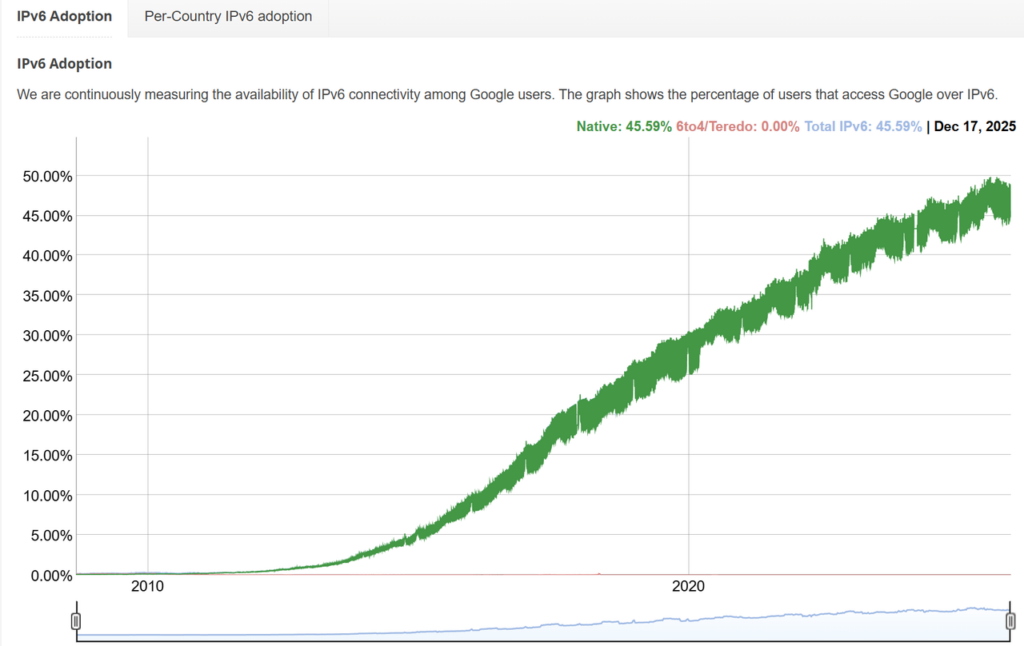
- As of early 2025, global IPv6 adoption stands at approximately 43–48%.
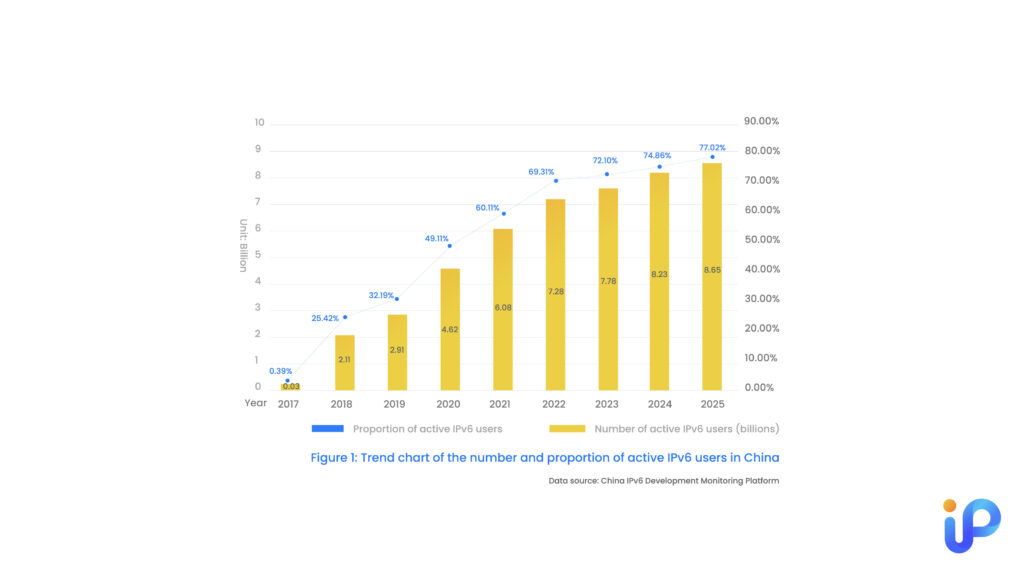
- In 2025, 77% IPv6 adoption in the Asia-Pacific region has reached a milestone. China alone has 865 million active IPv6 users.
In 2025, Google IPv6 users now reached 45%. IPv6 will achieve a 60 per cent share of Google visits quite soon.
Major mobile operators are at the forefront, with Reliance Jio in India achieving over 95% IPv6 adoption across its mobile network.
The knowledge that the transition to IPv6 addresses is inevitable has reduced the urgency for organizations to hoard IPv4 addresses, accelerating the market’s shift from a scarcity-driven model to a managed transition.
Will IPv4 address prices drop to “valueless”?

As of November 2025, the IPv4 market remains in a buyer’s market phase. Despite falling prices, the market shows remarkable liquidity, with over 18 million addresses transferred through May 2025.
Near-Term Outlook (2026)
- Prices are expected to remain stable or continue declining, as fundamental drivers, abundant supply and reduced hyperscaler demand, are likely to persist.
- The leasing market shows greater stability, with prices expected to remain increasing throughout 2026.
In a rapidly changing market, leasing is likely to remain the preferred option for organizations seeking flexibility, predictable costs, and lower upfront capital outlay. IPv4 Superhub is a reliable IPv4 address brokerage firm that can support your business growth by helping you secure leased IPv4 addresses quickly and efficiently.